Tuesday, September 13, 2011

A New and Improved Moore's Law

Researchers have, for the first time, shown that the energy efficiency of computers doubles roughly every 18 months.

The conclusion, backed up by six decades of data, mirrors Moore's law, the observation from Intel founder Gordon Moore that computer processing power doubles about every 18 months. But the power-consumption trend might have even greater relevance than Moore's law as battery-powered devices—phones, tablets, and sensors—proliferate.

"The idea is that at a fixed computing load, the amount of battery you need will fall by a factor of two every year and a half," says Jonathan Koomey, consulting professor of civil and environmental engineering at Stanford University and lead author of the study. More mobile computing and sensing applications become possible, Koomey says, as energy efficiency continues its steady improvement.

The research, conducted in collaboration with Intel and Microsoft, examined peak power consumption of electronic computing devices since the construction of the Electronic Numerical Integrator and Computer (ENIAC) in 1956. The first general purpose computer, the ENIAC was used to calculate artillery firing tables for the U.S. Army, and it could perform a few hundred calculations per second. It used vacuum tubes rather than transistors, took up 1,800 square feet, and consumed 150 kilowatts of power.

Even before the advent of discrete transistors, Koomey says, energy efficiency doubled every 18 months. "This is a fundamental characteristic of information technology that uses electrons for switching," he says. "It's not just a function of the components on a chip."

The sort of engineering considerations that go into improving computer performance—reducing component size, capacitance, and the communication time between them, among other things—also improves energy efficiency, Koomey says. The new research, coauthored by Stephen Berard of Microsoft, Marla Sanchez, at Carnegie Mellon University, and Henry Wong of Intel, was published in the July-September issue of IEEE Annals of the History of Computing.

In July, Koomey released a report that showed, among other findings, that the electricity used in data centers worldwide increased by about 56 percent from 2005 to 2010—a much lower rate than the doubling that was observed from 2000 to 2005.

While better energy efficiency played a part in this change, the total electricity used in data centers was less than the forecast for 2010 in part because fewer new servers were installed than expected due to technologies such as virtualization, which allowed existing systems to run more programs simultaneously. Koomey notes that data center computers rarely run at peak power. Most computers are, in fact, "terribly underutilized," he says.

The information technology world has gradually been shifting its focus from computing capabilities to better energy efficiency, especially as people become more accustomed to using smart phones, laptops, tablets, and other battery-powered devices.

Since the Intel Core microarchitecture was introduced in 2006, the company has experienced "a sea change in terms of focus on power consumption," says Lorie Wigle, general manager of the eco-technology program at Intel. "Historically, we have focused on performance and battery life, and increasingly, we're seeing those two things come together," she says.

"Everyone's familiar with Moore's law and the remarkable improvements in the power of computers, and that's obviously important," says Erik Brynjolfsson, professor of the Sloan School of Management at MIT. But people are paying more attention to the battery life of their electronics as well as how fast they can run. "I think that's more and more the dimension that matters to consumers," Brynjolfsson says. "And in a sense, 'Koomey's law,' this trend of power consumption, is beginning to eclipse Moore's law for what matters to consumers in a lot of applications."

To Koomey, the most interesting aspect of the trend is thinking about the possibilities for computing. The theoretical limits are still so far away, he says. In 1985, the physicist Richard Feynman analyzed the electricity needs for computers and estimated that efficiency could theoretically improve by a factor of 100 billion before it hit a limit, excluding new technologies such as quantum computing. Since then, efficiency improvements have been about 40,000. "There's so far to go," says Koomey. "It's only limited by our cleverness, not the physics." (Technologyreview)

Saturday, September 10, 2011

What It Takes to Power Google

Google is the first major Web company to reveal exactly how much energy it uses—information that will help researchers and policy makers understand how the massive explosion of Internet usage and cloud computing is contributing to global energy consumption.

Google uses 260 million watts continuously across the globe, the company reported on Wednesday. This is equivalent to the power used by all the homes in Richmond, Virginia, or Irvine, California (around 200,000 homes), and roughly a quarter of the output of a standard nuclear power plant.

By far, the majority of Google's energy use is tied up in its data storage centers, according to Jonathan Koomey, a professor at Stanford University and a researcher who focuses on energy and IT. He says that roughly 220 million of those watts are used solely by the company's data centers, based on figures Google showed him. Most of this energy is used in cooling data center systems. Google custom builds many data centers, such as a new one in Finland that uses a seawater cooling system, to cut down on electricity.

This has enabled Google to be relatively energy efficient, says Koomey, who estimates that the company owns about 3 percent of servers worldwide and uses only 1 percent of electricity for data centers worldwide. "They're operating more efficiently than other data centers," he says.

Other Web giants, including Amazon and Facebook, probably operate their data centers with similar efficiency due to hardware and software customization, and innovative cooling equipment, Koomey says. However, the majority of data center power use comes from non-IT companies running their own data centers less efficiently.

In its report, Google compares the energy usage of companies' in-house computer systems to the energy used by its cloud servers. It estimates that running Gmail instead of an in-house e-mail system can be almost 80 times more energy efficient. Google says that 25 percent of its energy was supplied by renewable fuels—such as from wind farms—in 2011, and plan to increase that to 30 percent this year.

Sherif Akoush, a researcher at the University of Cambridge who studies IT energy consumption, points out that Google could be even more energy efficient, and notes that the company's environmental footprint will continue to rise. "Google tackles this problem mainly by using power purchase agreements from green sources, which offset basically the emissions from its data centers," says Akoush. Instead, "it should just try to implement more radical solutions like green energy and be a zero-carbon company instead of pumping waste then trying to clean it up."

Bruce Nordman, a researcher at the Lawrence Berkeley National Laboratory, notes that most IT-related energy usage occurs from homes and offices, and not major data centers.

Google says that an average search uses .3 watt-hours of electricity. But Nordman points out that cutting back on Google searches is not going to save a significant amount of energy. "Something like having your display go to sleep a little faster would probably save more energy," he says.

He adds, "since there's more consumption [in homes and offices], there's potentially more savings and yet that's not what gets the attention." (Technologyreview)

Saturday, September 3, 2011

Quantum Processor Hooks Up with Quantum Memory

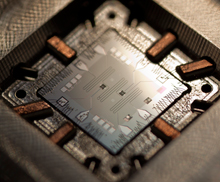
Researchers at the University of California, Santa Barbara, have become the first to combine a quantum processor with memory that can be used to store instructions and data. This achievement in quantum computing replicates a similar milestone in conventional computer design from the 1940s.

Although quantum computing is now mostly a research subject, it holds out the promise of computers far more capable than those we use today. The power of quantum computers comes from their version of the most basic unit of computing, the bit. In a conventional computer, a bit can represent either 1 or 0 at any time. Thanks to the quirks of quantum mechanics, the equivalent in a quantum computer, a qubit, can represent both values at once. When qubits in such a "superposition" state work together, they can operate on exponentially more data than the same number of regular bits. As a result, quantum computers should be able to defeat encryption that is unbreakable in practice today and perform highly complex simulations.

Linking a processor and memory elements brings such applications closer, because it should make it more practical to control and program a quantum computer can perform, says Matteo Mariantoni, who led the project, which is part of a wider program at UCSB headed by John Martinis and Andrew Cleland.

The design the researchers adopted is known as the von Neumann architecture—named after John von Neumann, who pioneered the idea of making computers that combine processor and memory. Before the first von Neumann designs were built in the late 1940s, computers could be reprogrammed only by physically reconfiguring them. "Every single computer we use in our everyday lives is based on the von Neumann architecture, and we have created the quantum mechanical equivalent," says Mariantoni.

The only quantum computing system available to buy—priced at $10 million—lacks memory and works like a pre-von Neumann computer.

Qubits can be made in a variety of ways, such as suspending ions or atoms in magnetic fields. The UCSB group used more conventional electrical circuits, albeit ones that must be cooled almost to absolute zero to make them superconducting and activate their quantum behavior. They can be fabricated by chip-making techniques used for conventional computers. Mariantoni says that using superconducting circuits allowed the team to place the qubits and memory elements close together on a single chip, which made possible the new von Neumann-inspired design.

The processor consists of two qubits linked by a quantum bus that enables them to communicate. Each is also connected to a memory element into which the qubit can save its current value for later use, serving the function of the RAM - for random access memory - of a conventional computer. The links between the qubits and the memory contain devices known as resonators, zigzagging circuits inside which a qubit's value can live on for a short time.

Mariantoni's group has used the new system to run an algorithm that is a kind of computational building block, called a Toffoli gate, which can be used to implement any conventional computer program. The team also used its design to perform a mathematical operation that underlies to the algorithm with which a quantum computer might crack complex data encryption.

David Schuster leads a group at the University of Chicago that also works on quantum computing, including superconducting circuits. He says that superconducting circuits have recently proved to be comparatively reliable. "One of the next big frontiers for these techniques now is scale," he says. By replicating the Von Neumann architecture the UCSB team have expanded that frontier.

That's not to say that quantum computers must all adopt that design, though, as conventional computers have. "You could make a computer completely out of qubits and it could do every kind of calculation," says Schuster. However there are advantages to making use of resonators like those that make up the new design's memory, he says. "Resonators are easier and more reliable to make than qubits and easier to control," says Schuster.

Mariantoni agrees. "We can easily scale the number of these unit cells," he says. "I believe that arrays of resonators will represent the future of quantum computing with integrated circuits." (Technologyreview)

Friday, August 26, 2011

Algorithms Tell Consumers When to Buy Tech Products

It's a classic question when a lovely new gadget comes out on the market: when is the right time to buy? Buy the product early, and you get bragging rights and more time enjoying its features, but you almost certainly pay more than if you'd waited.

Case in point: HP's departure from the tablet business, with its announcement last week that it would stop making its Touchpad. Touchpad owners who had paid the full price of $499 for a device unlikely ever to see new apps, peripherals, or support from its parent company were insulted further when HP discounted the Touchpad to $149 for the 32-gigabyte Wi-Fi edition and $99 for the 16-gigabyte model. In one weekend, an estimated 350,000 people bought Touchpads, at more than $300 off the prices they would have paid just a couple of months before.

"People are constantly feeling burned by all these things," says Oren Etzioni, chief technology officer and cofounder of Decide, a startup dedicated to helping consumers decide whether to buy products or wait. Etzioni says it's possible to automate intelligent predictions about product pricing based on several factors. The company arrives at these conclusions by monitoring price trends, news, rumors, and technical specifications. Decide has not yet launched predictions for the tablet category, but it currently makes recommendations for other consumer products, such as digital cameras.

Prior to starting Decide, Etzioni founded Farecast—acquired by Microsoft in 2008—which predicted the optimal time to buy airline tickets.

But predicting prices for consumer electronics is more complicated. Airline tickets get used once; consumer electronics are meant to be kept and enjoyed. People don't want to wait so long to buy a product that they're stuck with an outdated model, no matter how cheap it is. "We believe there's only a limited time people will wait," says Etzioni.

To formulate its insights, Decide factors in predictions of new models or discontinued service. It also might direct consumers to newer models instead of discounted old ones. In some cases, Etzioni says, new models actually cost less than predecessors due to high supply.

Microsoft, which researches price prediction for its Bing search engine, remains interested in the topic. Yesterday, at the 17th Association for Computing Machinery conference on Knowledge Discovery and Data Mining in San Diego, a group of Microsoft researchers presented work focused on calculating the value a product could offer a customer in relation to its price. "It is crucial to consider loss of use due to waiting," said researcher Samuel Ieong.

Ieong and colleagues studied price and sales data from the market research company NPD from January 2005 to September 2008 to predict the best times to buy products such as camcorders, digital cameras, printers, and television sets. They found that while more utilitarian products such as printers had fairly stable prices, flashier products such as digital cameras could vary wildly, leaving consumers playing tricky guessing games.

Etzioni says the long-term impact of price prediction could be huge. It's not just a question of when to buy a flashy new toy, he says. As companies become better at predicting prices and features for all types of devices, buying at the right time could help consumers own better-quality products across the board. For example, he says, buyers might be able to predict when to purchase a refrigerator, taking into account both price and energy efficiency over time. Small gains in efficiency could become significant for a household product that people often keep for decades, he says. (Technologyreview)

Sunday, August 21, 2011

Five Ways Apple Should Spend Its $76 Billion

Last week, Apple reported that it now has reserves of $76 billion in cash, short term securities and long term securities. As many wags pointed out, that's more than the cash-strapped U.S. government has left. On Tuesday, Apple also briefly surpassed Exxon Mobil to become the world's most highly valued company, at more than $340 billion in stock-market valuation.

With tens of billions of dollars to throw around and super-high investor confidence, shouldn't Apple reinvest in some cutting-edge R&D that could make it even more successful?

Apple has already shown the value of introducing unique new technologies for its products: the iPhone's advanced touchscreen and the MacBook's one-piece aluminum case, for example. Apple has also begun bringing CPU chip design and production closer to home, giving it another technological advantage.

So it wouldn't be a stretch for Apple to spend some of its cash on bringing new technologies into existence that competitors couldn't touch. Never mind buying Hulu or some other company. Here are five ways could Apple actually invent the future, and thwart other makers of phones, tablets, and computers.

5. Color screens that work in the sunshine
As much as I love printed books, I'd much rather tote a skinny little iPad for my on-the-go reading. But here in sunny Los Angeles, I can't see the color screen when I try to read outdoors. There's no way to read a book on a tablet at the beach, or in the park.

Of course mobile displays for reading in direct sunlight are already available, such as those on Amazon's Kindle, but they're only black-and-white, and they refresh at a painfully slow, page-turning speed. Now that a large chunk of my media consumption is in color, these displays don't cut it. Surely a daytime color display isn't impossible. With Apple's spare cash, could a breakthrough be around the corner?

4. Wireless network quality
Before Steve Jobs unveiled the original iPhone in 2007, he and his company pulled off a feat most pundits would have considered impossible: They got AT&T to change the way its voicemail system worked. Instead of forcing users to listen to all messages in order—a throwback to cassette-tape answering machines, and also good for getting customers to run up their minutes—the iPhone let its users view all messages onscreen at once and play only those they tapped.

But iPhone owners still complain bitterly about the quality of wireless service. AT&T drops calls, and Verizon won't let you make a voice call and use an Internet app at the same time. The audio quality of voice calls on any phone, through any carrier, seems to have gotten worse rather than better. If Apple could fix these issues, iPhone calls could become a premium feature rather than a joke. It might require a multi-billion-dollar investment in wireless network infrastructure, but we know who's got the money to spend.

3. Hands-free interfaces
Yes, I've figured out how to swipe at the latest version of Mac OS X. But you know what would be even better? Being able to wave at my iPhone instead of having to fumble with the keypad. Once you've tried Oblong Technology's hands-free interface, even a touchscreen seems dated.

The only problem is that Oblong's system is still too expensive for the mass market. Apple is legendary for turning Xerox's high-end mouse-and-menu workstations into affordable Macintoshes in the early 1980s. Couldn't they do the same with a hands-free interface?

2. Education
Another form of R&D: Give your products to a whole bunch of kids. In 2002, Apple began helping the state of Maine leapfrog its students ahead of wealthier states by giving Maine's schools a special deal on notebooks. Every seventh- and eighth-grader in Maine gets an Apple laptop that they can take home after school. Classrooms have wireless networks. Not only are the kids learning to use the tools they'll someday encounter in real-world jobs, but they're also being trained to prefer Apple over Windows. Apple has long focused on the educational market for both ideological and marketing reasons. Now would be a good time for a big national giveaway on MacBooks or iPads for future geniuses—and future customers.

1. Reinvent the battery
What's the biggest problem with your phone, laptop, or music player? It runs out of juice when you're nowhere near a power supply to recharge it. Even with a less thirsty CPU, energy-saving software, and premium batteries packed into as much internal space as possible, Apple's products can't hold enough power for a full day of heavy use for most customers.

Battery technology has advanced much more slowly than chips and displays. Apple's approach to product design—don't just think outside the box, replace the box entirely—could change the way mobile gadgets are powered. Is there a battery technology waiting to be discovered that blows past lithium-ion tech?

Could a new kind of battery be recharged without a special power adapter, or even without a wall socket? If my phone is about to conk out, could I get it to last a few minutes longer by shaking it? I'm fond of my Android phone, but its less-than-all-day battery life has caused me plenty of problems, and before day's end I often run down both the battery in the phone and the spare battery I carry with me. If Apple offered an iPhone that I could use in the real world for a week without a recharge, I'd switch on the spot.

Of course, what has made Apple so special for decades isn't fulfilling my wishes, but going beyond them. Dear Steve Jobs: Please bring me yet another gadget I would never have even thought of. Now more than ever, you can afford to do that. (Technologyreview)

IBM's New Chips Compute More Like We Do

A microchip with about as much brain power as a garden worm might not seem very impressive, compared with the blindingly fast chips in modern personal computers. But a new microchip made by researchers at IBM represents a landmark. Unlike an ordinary chip, it mimics the functioning of a biological brain—a feat that could open new possibilities in computation.

Inside the brain, information is processed in parallel, and computation and memory are entwined. Each neuron is connected to many others, and the strength of these connections changes constantly as the brain learns. These dynamics are thought to be crucial to learning and memory, and they are what the researchers sought to mimic in silicon. Conventional chips, by contrast, process one bit after another and shunt information between a discrete processor and memory components. The bigger a problem is, the larger the number of bits that must be shuffled around.

The IBM researchers have built and tested two demonstration chips that store and process information in a way that mimics a natural nervous system. The company says these early chips could be the building blocks for something much more ambitious: a computer the size of a shoebox that has about half the complexity of a human brain and consumes just one kilowatt of power. This is being developed with $21 million in funding from the Defense Advanced Research Projects Agency, in collaboration with several universities.

The company's researchers and their academic collaborators will present two papers next month at the Custom Integrated Circuits conference in San Jose, California, showing that the chip designs have very low power requirements and work with neural-circuit-mimicking software. In one experiment, a "neural core," as the new chips are called, learns to play Pong; in another, it learns to navigate a car on a simple race track; and in another it learns to recognize images.

Conventional computers have become very powerful, but they require huge amounts of capacity and power to mimic tasks that humans take for granted. IBM's Watson computing system, for example, famously beat two of the best human Jeopardy! players in a match this February. But it needed 16 terabytes of memory and a cluster of tremendously powerful servers to do so.

"The brain has solved these problems brilliantly, with just 10 watts of power," says Kwabena Boahen, a professor of bioengineering at Stanford University who is not currently involved with the IBM project. "A machine with the intelligence we have could read and make connections, pull in information and make sense of it, rather than just make matches."

How such a "cognitive computer" should be designed and how it should operate is controversial, however. After all, biologists still don't understand how the brain works.

IBM has released only limited details about the workings and performance of its new chips. But project leader Dharmendra Modha says the chips go beyond previous work in this area by mimicking two aspects of the brain: the proximity of parts responsible for memory and computation (mimicked by the hardware) and the fact that connections between these parts can be made and unmade, and become stronger or weaker over time (accomplished by the software).

The new chips contain 45-nanometer digital transistors built directly on top of a memory array. "It's like having data storage next to each logic gate within the processor," says Cornell University computer scientist Rajit Manohar, who's collaborating with IBM on hardware designs. Critically, this means the chips consume 45 picojoules per "event," mimicking the transmission of a pulse in a neural network. That's about 1,000 times less power than a conventional computer consumes, says Gert Cauwenberghs, director of the Institute for Neural Computation at the University of California, San Diego.

So far the IBM team has demonstrated only very basic software on these chips, but they have laid the foundation for running more complex software on simpler computers than has been possible in the past. In 2009, Modha's group ran simulations of a neural network as complex as a cat's brain on a supercomputer. "They cut their teeth on massive simulations," says Michael Arbib, director of the USC Brain Project. "Now they've come up with chips that may make it easier to [run cognitive computing software]—but they haven't proven this yet," he says.

Modha's group started by modeling a system of mouse-like complexity, then worked up to a rat, a cat, and finally a monkey. Each time they had to switch to a more powerful supercomputer. And they were unable to run the simulations in real time, because of the separation between memory and processor that the new chip designs are intended to overcome. The new hardware should run this software faster, using less energy, and in a smaller space. "Our eventual goal is a human-scale cognitive-computing system," Modha says. (Technologyreview)

Saturday, August 20, 2011

Google's Vision for TV Proves a Turn off

Google's hopes of becoming a force in television by releasing software that brings Web video and other online content—including ads—to the small screen appear to be fading fast. In recent months, stores and distributors selling one flagship Google TV device returned more of them than they sold as consumer demand fell.

That embarrassing statistic appeared in a July 28 earnings announcement released by Logitech. The announcement covered the fiscal quarter ending June 30. The company's Revue set-top box was announced in partnership with Google when the search giant introduced its TV software last October. Sony was also part of the launch, and sells television sets with Google TV built in.

But Google TV devices have gained little traction. They launched to poor reviews citing them as difficult to use, and met opposition from broadcast and cable networks wary of the Web content might undermine their hold on viewers. Competition from less expensive machines from Apple and Roku, as well as from game consoles, has been intense.

Logitech chairman and acting CEO Guerrino De Luca told analysts that Google TV has "not yet fully delivered on its own promises." His company had already cut the price of the Revue from $299 to $249. Now the price will be slashed to $99, on par with Apple and Roku's Internet TV devices. Logitech has other challenges, such as distribution problems in Europe that led to flat revenues. However the first Revue price drop and the returns cost Logitech $34 million, and contributed to the departure of De Luca's predecessor, Gerald Quindlen.

Google TV is not finished, though. Apple TV soared in popularity after a similar price drop last September, and Google says it's not giving up. "We launched Google TV with a firm belief that bringing the power of the Web into the living room will significantly enhance the television experience," a spokesman said in a statement. "We believe in this now more than ever."

A new version of Google TV will soon be released for new and existing devices later this summer. These devices may come with a simpler interface (consumers and reviewers have complained that the current version is too complicated).

Google appears to have long-term plans, too. It recently acquired SageTV, which makes software to turn a personal computer with a TV tuner card into a media center capable of recording, pausing, and streaming shows to devices around the home. Observers said Google bought the company more for the talent of its management team than its product, but it will take more time to apply that expertise to new software.

Google may also have an ace up its sleeve in the form of its mobile app store, the Android Market, a version of which is due to appear on Google TV devices later this year. Software developers are expected to create apps that bring new services to TV, from online social games to apps that turn smart phones and tablets into remote controls. "When Android Market opens up Google TV to more apps, we'll start to see things come about that we haven't thought of before," says Rakesh Agrawal, CEO of SnapStream, which sells technology that enables government agencies and TV production companies to search TV content.

Yet Google's toughest challenge is to convince TV studios and networks to stop deliberately obstructing its service. Days after Google TV debuted last October, CBS, NBC, and ABC started blocking shows freely available on their websites from being viewed using Google TV devices. Attempts to convince the broadcast and cable networks that Google TV was a complement, not a competitor, were fruitless.

That has left a big hole in what users can view on Google TV devices. Virtually every other competitor offers access to the online TV service Hulu, for example, which is operated by a coalition of broadcasters.

Google TV isn't yet a lost cause, according to people who closely watch the still-emerging market for so-called Connected TVs and devices. "The consumer home media experience is set for massive disruption," says Jeremy Toeman, chief product officer for Dijit, a San Francisco startup whose software turns a smart phone into a TV remote control with a program guide and social networking. But unless Google can give consumers a reason to crave Google TV, the company may play only a bit part in that disruption. (Technologyreview)

Friday, August 19, 2011

Personal Security

Many medical implants, such as insulin pumps and pacemakers, are equipped with wireless radios that let doctors download data about the patient's condition and adjust the behavior of the implant. But these devices are vulnerable to hackers who can eavesdrop on stored data or even reprogram the implant, causing, for example, a pacemaker to shock a heart unnecessarily. While it may be possible to engineer new, more secure implants, millions of people are walking around with vulnerable devices that can't be replaced without surgery. An anti-hacking device presented this week at the annual SIGCOMM communications conference in Toronto may offer them a solution.

Created by researchers from MIT and the University of Massachusetts, Amherst, the laptop-sized device, called "the shield," emits a jamming signal whenever it detects an unauthorized wireless link being established between an implant and a remote terminal (which can be out of sight and tens of meters away). Although no attack of this kind is known to have occurred , "it's important to solve these kinds of problems before the risk becomes a tenable threat," says Kevin Fu, an associate professor of computer science at UMass and one of the developers of the shield. Fu was Technology Review's Young Innovator of the Year in 2009 for his work in uncovering the previously unsuspected danger that hackers pose to implant wearers.

The key innovation is the new radio design that the shield uses for jamming. "If you just do simple jamming [broadcasting radio noise on a given frequency], then the attacker doesn't get the information, but the doctor doesn't either," says Dina Katabi, another developer of the shield and an associate professor of electrical engineering and computer science at MIT. Instead, the shield allows a jamming signal to be broadcast while it simultaneously receives data signals from the implant and relays them over a secure link. So doctors can still download data and confirm adjustments even while the shield is jamming an attacker.

Normally, trying to get a radio to detect data while it's broadcasting on the same frequency is like attaching a hearing aid to a megaphone on full blast and expecting the hearing aid to pick up a nearby conversation. Earlier attempts to make radios capable of simultaneously transmitting and receiving on the same frequency relied on a carefully spaced trio of antennas. But at the frequencies used in medical devices (about 400 megahertz), this spacing would result in a jamming device far too big for a person to carry. Instead, the researchers worked out how to use two closely spaced antennas: one for receiving and the other for broadcasting the jamming signal. The trick is to feed an "antidote" signal to the jamming signal into the receiving antenna, canceling out the jamming noise. (Technologyreview)